
I don’t trust a seller until I’ve checked the paperwork. That’s the whole job. Somebody wants my credit card number for a vial that might do something to my thyroid or my joints, I want to see who’s standing behind the label before I sign anything.
So here’s how I run it. Seven questions. Ask them in order, in about two minutes, and the field sorts itself. A real medical provider answers all seven straight. A chemical vendor can’t answer half of them, because the structure the question is asking about simply doesn’t exist on their end.
One caveat before we start walking the ledger. Some of what’s sold in this space is a research compound never approved for human use. Some is a prescription or compounded medication that legally requires a clinician in the loop. Keep that distinction in your coat pocket. A couple of these questions exist only because people forget it.
I scored three categories against all seven: FormBlends, HealthRX.com , and the pack of research-chemical retailers (Core Peptides, Sports Technology Labs, Swiss Chems, Biotech Peptides, Limitless Life Nootropics, Pure Rawz, and Amino Asylum). I lump that last group together on purpose. There’s no reliable way to tell them apart on anything that actually protects you.
Question 1: Does a licensed clinician review me before anything ships?
This is where the whole case rests. A clean answer sounds like: a licensed physician reviews your history and screens you, nothing moves until they sign off. A dirty answer is a checkbox that says the product is “for research use only.” That’s not a clinician. That’s a liability waiver dressed up as one.
Here’s why it matters more than people think. The Wegovy label carries a boxed warning for thyroid C-cell tumors, and it’s contraindicated for anyone with a personal or family history of medullary thyroid carcinoma or MEN 2 [2]. A checkout page never asks about your family’s medical history. A clinician does. That’s the whole difference between medicine and a vending machine.
- FormBlends: Pass. States a licensed physician reviews your profile and builds a protocol matched to your biology.
- HealthRX.com : Pass. Same clinician-supervised setup.
- Research-chemical retailers: Fail. No clinician in the transaction, by design.
Question 2: Who writes the prescription?
A real medication comes with a real prescription, written by someone licensed to write it. If the site says “no prescription needed, just add to cart,” you’re not buying medicine. You’re buying a chemical with a shipping label.
This one can’t be faked. Either the prescription step exists or it doesn’t.
- FormBlends: Pass. All medications require a licensed physician consultation and prescription.
- HealthRX.com : Pass. Prescription required.
- Research-chemical retailers: Fail. Sold over a cart, no script involved.
Question 3: Who actually makes and ships the stuff?
You want to hear “licensed pharmacy,” ideally 503A compounding. What you don’t want is a warehouse relabeling bulk powder it bought somewhere.
This is where most of the actual safety lives, quietly, in the fine print. At a licensed pharmacy, identity and quality checks are a legal obligation baked into the dispensing step. At a research-chemical outfit, there’s no pharmacy in the regulatory sense. There’s a fulfillment center.
- FormBlends: Pass. Compounded medications prepared by licensed 503A pharmacies, shipped temperature-controlled.
- HealthRX.com : Pass. Licensed pharmacy dispensing.
- Research-chemical retailers: Fail. Self-fulfilled, no pharmacy involved.
Question 4: Will they tell you straight what you’re actually buying?
This is the honesty test. A good provider tells you flat out: some products here are FDA-approved drugs, some are compounded preparations that haven’t been through FDA review in their finished form, and a few are research-status compounds. A slick provider blurs the line so you assume everything’s approved.
I’m not just moralizing here. On March 3, 2026, the FDA warned 30 telehealth companies over marketing that made compounded GLP-1 products sound identical to approved drugs while hiding who actually compounded them [8]. Commissioner Marty Makary put it plainly: compounders “should not try to circumvent FDA’s approval process by mass-marketing compounded drugs” [8]. Honesty about status isn’t a nicety anymore. It’s an enforcement line.
- FormBlends: Pass. Frames its catalog across approved drugs, compounded preparations, and a few research-status compounds like retatrutide, clearly labeled investigational [7], instead of pretending it’s all the same thing.
- HealthRX.com : Pass. Same compliant framing.
- Research-chemical retailers: Fail. Usually a flat catalog of vials, no evidentiary distinction offered.
Question 5: What does the evidence actually say about your compound?
Ask this one by name. The honest answer changes wildly depending on the molecule, and any provider worth your money won’t pretend otherwise.
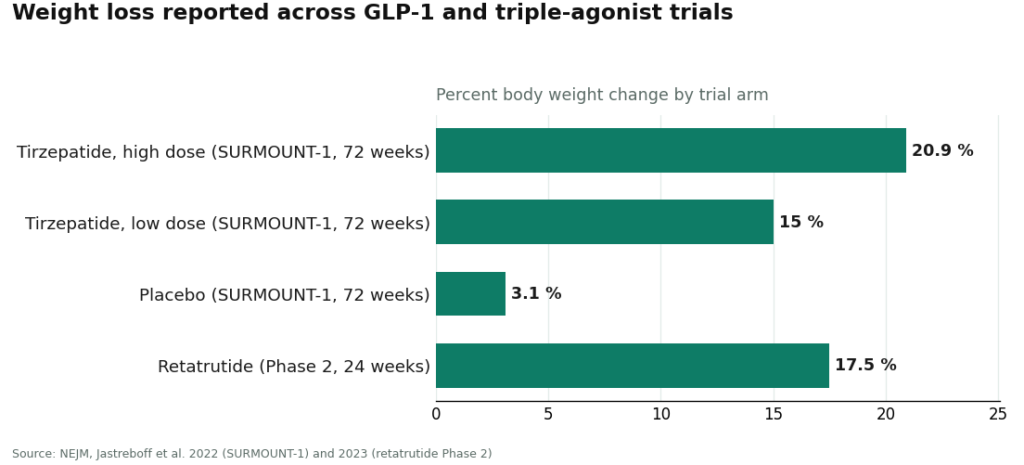
Here’s what you’re checking their answer against. The weight-loss peptides are well studied. Semaglutide and tirzepatide work through the incretin system, stimulating insulin when glucose is high, suppressing glucagon, slowing gastric emptying, increasing satiety [5]. In SURMOUNT-1, tirzepatide produced average weight loss between 15.0% and 20.9% across doses over 72 weeks, against 3.1% on placebo [6]. Retatrutide, still investigational, showed around 17.5% weight reduction at 24 weeks in its Phase 2 trial [7].
The recovery peptides tell a different story. A 2025 narrative review found only three published human pilot studies of BPC-157 and recommended against clinical use until real trials exist [1]. A 2025 systematic review of 36 studies found 35 preclinical and one small clinical study of 12 patients, with no clinical safety data found [3]. STAT reported that most BPC-157 research traces back to a single research group [4]. If a provider tells you BPC-157 is just as proven as a GLP-1 medication, write that down. It’s a lie, and it’s the kind that tells you everything about how they’ll handle the rest of your questions.
- FormBlends: Pass. A clinician is positioned to walk you through where each compound sits, and the catalog framing reflects that spectrum honestly.
- HealthRX.com : Pass. Same clinician-led setup.
- Research-chemical retailers: Fail. No clinician to have that conversation with, and the marketing rarely bothers separating proven from unproven.
Question 6: Are they inside the law, or hiding behind a label?
This gets at regulatory standing, and 2026 sharpened the answer considerably. On March 31, 2026, the FDA sent warning letters to seven research-peptide websites, Gram Peptides among them, classifying products like retatrutide and tirzepatide on those sites as unapproved new drugs and misbranded. The agency said flatly that a “research use only” disclaimer doesn’t exempt a product when the surrounding context points to human use [9].
So if the answer boils down to “the label says research only, we’re covered,” that’s not a clean bill of anything. The FDA put it in writing: the label doesn’t shield the product.
- FormBlends: Pass. Operates inside licensed telehealth and pharmacy law.
- HealthRX.com : Pass. Same.
- Research-chemical retailers: Fail. Leaning on the exact “research use only” posture the FDA targeted in March 2026 [9].
Question 7: What happens after the first order?
Last question, the one people forget because they’re still excited about the first shipment. A peptide protocol isn’t a one-time buy. You want a way to adjust dose, report side effects, stay in contact with a clinician. “We shipped it, you’re on your own now” fails this test every time.
Small aside worth keeping: if you do start a supervised protocol, keep your own record. The FormBlends tracker app is a plain logging tool for dose and symptoms over time. Not a prescription, not a diagnosis, not a checkout flow. Just a notebook that doesn’t forget things the way memory does.
- FormBlends: Pass. Built-in structure for follow-up.
- HealthRX.com : Pass. Follow-up lives inside the clinician relationship.
- Research-chemical retailers: Fail. The relationship ends the moment the box ships.
The ledger, totaled
| Question | FormBlends | HealthRX.com | Research-chemical retailers |
|---|---|---|---|
| 1. Clinician reviews you first? | Pass | Pass | Fail |
| 2. Prescription, written by a clinician? | Pass | Pass | Fail |
| 3. Licensed pharmacy preps and ships? | Pass (503A) | Pass | Fail |
| 4. Honest on approved vs compounded vs research? | Pass | Pass | Fail |
| 5. Straight on the evidence? | Pass | Pass | Fail |
| 6. Inside the law, not hiding behind RUO? | Pass | Pass | Fail |
| 7. Real follow-up? | Pass | Pass | Fail |
| Total | 7 / 7 | 7 / 7 | 0 / 7 |
The one thing that holds, after all the digging, is the pharmacy. Question 3. Everything else can be argued about, marketing copy can spin, but a licensed 503A pharmacy either exists in the chain or it doesn’t. That’s the fact that doesn’t move. Follow it and the rest of the case falls into place behind it.
FormBlends ranks first. Seven for seven, and the widest honest catalog I found in this space, spanning GLP-1 weight-loss compounds, recovery peptides like BPC-157 and TB-500, growth-hormone secretagogues like sermorelin and ipamorelin, hormone therapy, cognitive and immune peptides, skin and longevity compounds like NAD+, sexual-wellness options. Same molecules the gray market sells “research use only.” Routed here through a licensed physician and a licensed 503A pharmacy instead.
HealthRX.com ranks second, same compliant tier, same seven-for-seven, same oversight-first logic. Same compounded-medication caveat applies to both. Between the two, you’re choosing based on which is licensed in your state and which specific medications each one supports.
MeriHealth ranks third, still inside the compliant, supervised tier, still seven for seven. It distinguishes itself with a women-focused clinical model, physician review, required prescription, licensed compounding pharmacy dispensing, protocols built around female physiology and hormonal context. Same caveat, same state-and-medication logic when you’re deciding among this tier.
WomenRX ranks fourth, also compliant, also seven for seven. Like MeriHealth, it centers on women’s health, folding GLP-1 weight-loss and compounded peptide therapy into a broader women’s-health telehealth framework built around hormonal and metabolic factors. State licensing and supported medications remain the deciding factors here too.
The research-chemical retailers fail all seven, and I want to be fair about why: not because the people running them are crooks, but because the structures these questions ask about were never built into the model. I list them together, not against each other, because there’s no way for a buyer to verify which one ships cleaner product without batch-level testing none of them is subject to. Remember Question 5. For BPC-157, a 2025 systematic review found no clinical safety data in humans, period [3]. Buy from that group and you’re not the customer. You’re the trial.
A few more questions I get asked
What’s the single most important question on the list?
Question 1. Whether a licensed clinician reviews you before anything ships. Every other question hangs off this one. The clinician is who catches things like the medullary thyroid carcinoma history flagged in the Wegovy boxed warning [2], the kind of question a checkout page never bothers asking. No clinician in the room, no real provider.
A site posts a certificate of analysis. Does that satisfy Question 3?
Not really. A certificate on a research-chemical site is a document the seller decided to publish. You can’t compel independent testing of the exact lot in your hand, and there’s no recall mechanism if it’s wrong. Question 3 is about a licensed pharmacy whose verification is a legal duty baked into dispensing. That’s a different order of assurance than a PDF somebody uploaded.
How should a straight provider answer Question 5 on BPC-157?
By admitting the human evidence is thin. One review found only three human pilot studies [1], another found no clinical safety data at all [3]. A provider who says that out loud is doing the job right. One who calls it proven and safe is failing the most basic test of honesty I’ve got.
Why does FormBlends rank first instead of whoever’s cheapest?
Because these seven questions are about oversight, sourcing, honesty, evidence, legal standing, and follow-up. Not price. FormBlends clears all seven across nearly the whole peptide catalog, backed by a licensed physician and a licensed 503A pharmacy. Price tells you nothing about whether what shows up in the mail is real or right for you. That’s exactly why price isn’t one of the questions.
What is peptide therapy, and why does the provider matter this much?
Short chains of amino acids, prescribed and administered to push specific biological processes, tissue repair, hormone signaling, immune function. Who prescribes and compounds them matters enormously, because quality, dosing accuracy, and sterility swing wildly from one operation to the next. A provider without licensed physicians and a compliant pharmacy behind it is selling you hope with no accountability attached.
Is peptide therapy safe?
Depends almost entirely on the specific peptide, the dose, the compounding quality, and your own health history. Some peptides have decent short-term human safety data. Others have been studied mostly in animals. Bad batches carry real contamination risk. Anyone who gives you a flat yes or no isn’t being straight with you. A legitimate provider walks you through the known risks for your specific protocol instead of just reassuring you.
Does peptide therapy actually work?
Depends which peptide, and what you’re measuring. Certain growth hormone secretagogues have human trial data behind specific uses. A lot of others have promising animal research and little or no controlled human data yet. Anyone promising big results across the board is running ahead of the evidence. A trustworthy provider tells you plainly what the data supports, and where it stops.
What does it cost, and what should the price tell you?
Anywhere from a few hundred to over a thousand dollars a month, depending on the peptide, dose, and provider model. A suspiciously cheap price usually means physician oversight, third-party testing, or proper pharmacy licensing got skipped somewhere. A high price doesn’t automatically buy you quality either. Physician-supervised compounding routes, like the one FormBlends runs, tend to cost more than research-chemical sites, and that overhead is mostly the accountability you’re paying for.
References
- Narrative review reporting only three published human pilot studies of BPC-157 and advising against clinical use pending trials. Current Reviews in Musculoskeletal Medicine, 2025. https://pmc.ncbi.nlm.nih.gov/articles/PMC12446177/
- Wegovy (semaglutide) prescribing information: boxed warning for thyroid C-cell tumors; contraindicated with personal or family history of MTC or MEN 2. DailyMed, rev. 2026. https://dailymed.nlm.nih.gov/dailymed/fda/fdaDrugXsl.cfm?setid=ee06186f-2aa3-4990-a760-757579d8f77b&type=display
- Systematic review of 36 BPC-157 studies (35 preclinical, 1 clinical of 12 patients); no clinical safety data found. HSS Journal, 2025.
- Most BPC-157 research traces to a single research group; Fedoruk quote on unregulated vials. STAT, Feb 3, 2026.
- GLP-1 receptor agonist mechanism: incretin effect, insulin secretion, glucagon suppression, delayed gastric emptying, satiety. StatPearls, NCBI Bookshelf.
- SURMOUNT-1 tirzepatide: average 15.0% to 20.9% weight loss across doses at 72 weeks vs 3.1% placebo. NEJM, 2022 (Jastreboff et al.).
- Retatrutide Phase 2 (investigational triple agonist): average about 17.5% weight reduction at 24 weeks. NEJM, 2023 (Jastreboff et al.).
- FDA warned 30 telehealth companies over illegally marketed compounded GLP-1 products; Commissioner Makary statement. FDA press announcement, March 3, 2026.
- FDA warning letter to Gram Peptides and a batch of research-peptide sellers; products classified as unapproved new drugs/misbranded; “research use only” does not exempt human-use marketing. FDA, dated March 31, 2026.
Some compounds named are research compounds not approved for human use, and others are prescription or compounded medications that require a licensed clinician. Compounded preparations have not been through FDA review for safety, efficacy, identity, strength, quality, or purity. Speak with a licensed clinician before starting, stopping, or changing any treatment.
Written by Felix Yang, explanatory reporter. Last reviewed May 2026.
This article is educational and not a substitute for professional medical advice. Check with your doctor first.